
“That’s the most foul, cruel, and bad-tempered rodent you ever set eyes on!… He’s got huge, sharp… er… He can leap about. Look at the bones!” — Monty Python and the Holy Grail
By Gregory J. Krabacher, Epstein Becker Green, P.C.
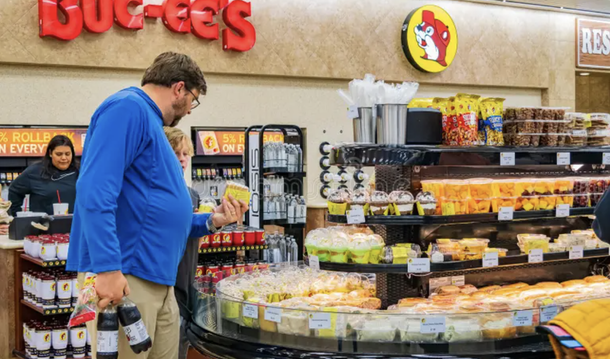
Buc-ee’s, Ltd. operates a chain of stores and travel centers under the name “BUC-EE’S.” In addition to this name, it brands the stores with a logo of a rodent, which, though perhaps not obvious to everyone, depicts a cartoon beaver. As the owner is proud to note, its stores “are not like other convenience stores. They are ‘highway oases’” and are sometimes referred to as “The Disneyland of convenience stores.”1
Buc-ee’s has gained notoriety in the U.S. not only for its loyal fan base of interstate travelers, but also for its aggressive trademark-enforcement strategy. This enforcement has included challenging all manner of cartoon animals used by small convenience stores and an expanding variety of other merchants across the country. Buc-ee’s has run up a string of victories (mostly quick settlements) by carefully selecting weaker opponents and pressing its advantage. As the inevitable backlash has built, these cases have attracted media attention. For example, comedian and talk-show host John Oliver has featured Buc-ee’s on at least two segments of his show on HBO2 and even launched a parody website, Buc-off.com, essentially daring Buc-ee’s to pick on someone prepared to defend themselves.
Two recent cases filed in my home state of Ohio illustrate the strategy. In the first, Buc-ee’s sued the operator of a northern-Ohio convenience chain that had rebranded as “Mickey’s” and was using a cartoon-moose (you heard that right, a MOOSE) mascot.3 That case reportedly settled on September 15, 2026.4 Regardless of the merits, which certainty seem debatable, it’s understandable why Mickey’s (and those other defendants) would want to settle quickly. When staring down a series of projectiles hurled from behind an impenetrable fortress, the only sensible thing to do is run away. It’s really the brave thing to do. Just ask Sir Robin.
In the other Ohio case, Buc-ee’s sued a single-location mini-mart operating as BEAVERS MINI MART in…wait for it… Beavercreek, Ohio. That case appears to expand Buc-ee’s already broad assertion of exclusive rights beyond the BUC-EE’S name and logo. In this latest case, the challenged business does not use either. Here is the signage of each party:5
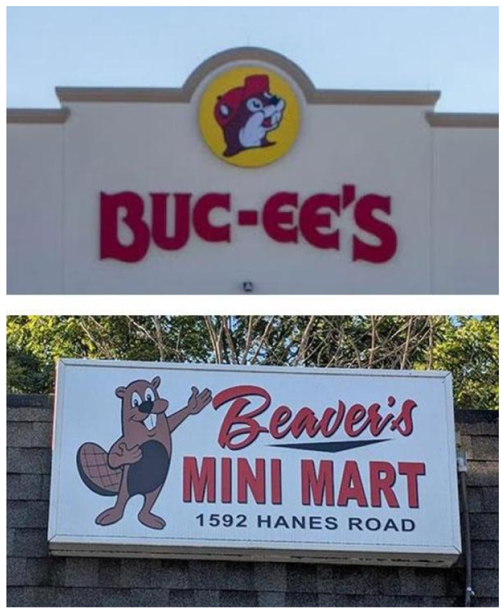
Ohio Governor Mike DeWine demonstrated a strong intuitive grasp of the likelihood-of-confusion standard when he reportedly observed: “I don’t think anybody looks at that and thinks, ‘Oh, that’s the Beaver of Buc-ee’s.’”6 He further noted: “It’s Beavercreek, for heaven’s sake. You expect to find — in Beavercreek — things named ‘beaver.’”7
I registered my own skepticism of any likelihood of confusion when this case was filed, further observing that while most brands are sensitive to the potential backlash that a David-versus-Goliath scenario can engender, the Buc-ee’s company, like its chain of “highway oases,” is different. 8 I speculated that Buc-ee’s — a place that sells probably 30 varieties of meat stick — may well have made a calculation that aggressiveness is not a negative thing for its core market.9
There Are Some Who Call me…Beaver’s?
While the “Buc-ee’s” name and logo may be less obviously applicable to the Beavercreek mini mart given the lack of resemblance to the marks used by the Defendant, Buc-ee’s has another card to play. Perhaps surprisingly, Buc-ee’s has successfully registered a trademark for the word “BEAVER’S,” which registration has now achieved incontestability status (the import of which is discussed below).10
Interestingly, there appear to be real questions about the validity of this registration and Buc-ee’s rights to enforce it. In the U.S., trademark rights depend upon “the bona fide use of a mark in the ordinary course of trade, and not made merely to reserve a right in a mark.”11 All those words are hard coded into the statute. As others have observed,12 the evidence submitted by Buc-ee’s to the United States Patent and Trademark Office (USPTO) to support its claim to BEAVER’S includes images such as the one below:
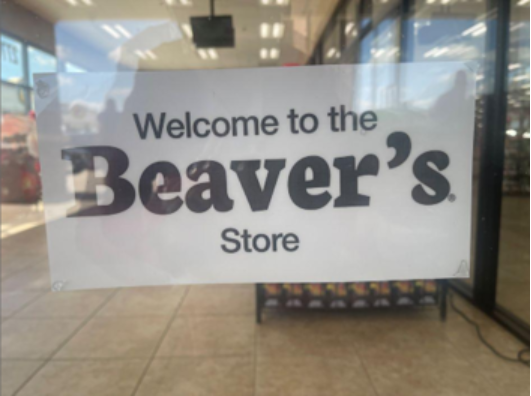
From the limited information readily available, this certainly seems like a coached legal strategy creating a marketing dilemma for Buc-ee’s. On the one hand, it seems to want to increase its elbow room in the marketplace by building exclusive rights in the word BEAVER’S to block defendants, such as the Mini Mart in Beavercreek, for whom the main Buc-ee’s trademarks do not clearly reach. On the other hand, the marketing prerogative for Buc-ee’s, like any brand, is to drive and maintain name recognition through consistent and prominent use of its primary marks. This attempt to walk the fine line between actual “use in commerce” and “token use” creates a factual question in every case the BEAVER’S mark is asserted.
Whether or not Buc-ee’s use of BEAVER’S is real or token, any defendant seriously considering going the distance in an infringement suit would surely find this question a worthwhile area to pursue. Doing so could possibly cut the legs out from under Buc-ee’s claims. For example, in a now dated case, the Federal Circuit, which hears appeals of decisions by the USPTO Trademark Trial and Appeals Board (TTAB), found even marks registered decades ago are cancellable as “void ab initio” where the predicate use in commerce was never established by the owner.13
In the present case, the issue would need to be framed differently to account for changes in law and the specific interpretation within the Sixth Circuit, where the Hanes Road case was brought. As explained below, rather than arguing the registration is void ab initio, the better framing is to argue abandonment and possibly fraud, to reach the same result.
The crucial point is that incontestability does not equate to invincibility. While achieving incontestability status limits certain challenges to a five-year window following registration, Congress left open a narrow list of certain other challenges that can be brought “at any time.”14 As the Sixth Circuit has reasoned, since a “void ab initio” challenge is not among those grounds, it cannot, by that name, undo a five-year-old registration.15
But the same proof of “token” use that would render a mark void ab initio as framed by the Federal Circuit in the earlier case, could still reach the BEAVER’S registration on grounds that do survive incontestability under the law of the Sixth Circuit today. First, the Trademark Modernization Act of 2020 added a non-use cancellation ground: a registration may be cancelled “[a]t any time after the 3-year period following the date of registration, if the registered mark has never been used in commerce” for some or all of the recited services.16 Second, and independently, an incontestable mark remains vulnerable to cancellation for abandonment, with three years’ nonuse serving as prima facie proof.17 The Southern District of Ohio has recently confirmed that a federal court may cancel even an incontestable mark on these grounds.18 In short, the result is the same under the alternative label. In the U.S., registered trademark rights are incompatible with a failure to use the mark in the ordinary course of trade. It’s a use it or lose it proposition. And so, while Buc-ee’s has asserted rights to its BEAVER’S registration against the proprietor of Beaver Mini-Mart in Beavercreek, Ohio, the Mini-Mart could, if it so chose, counter-sue for invalidity.
But the point of this article is not the bicker and argue about who sued who (this is a litigation, and is meant to be a happy occasion).
Taking the current case of Buc-ee’s, Ltd. v. Hanes Road Carryout, Inc. as an object lesson, we will use the remainder of this space to examine the uniquely American interplay between common law and registered rights to examine their impact on geographic priority.
’Tis But A Scratch…A Mere Flesh Wound
Let’s get one factual question out of the way first. The Buc-ee’s Complaint rather obliquely references defendant’s State of Ohio trade-name registration of BEAVERS MINI MART.19 From there the trail is not hard to follow. This registration was filed only recently, in October 2025, and claims a date of first use January 1, 2025.20 The implication seems to be that, knowing that Buc-ee’s was coming to town, this local proprietor opportunistically rebranded its store to free-ride on Buc-ee’s notoriety.
The Mini-Mart owners appear to dispute that account. Despite what they filed with the Ohio Secretary of State, they reportedly claim, and Internet archives of Google maps reportedly seem to support, that a BEAVERS MINI MART sign was actually installed by the Defendants much earlier, back in 2019.21 This appears to be prior to Buc-ee’s announcing any intention of opening stores in Ohio and certainly earlier than the date Buc-ee’s broke ground on its Huber Heights travel center in 2024.22 It’s also way before the travel center opened in April 2026.23
Would Buc-ee’s be held to its statements in the Ohio trade-name registration regarding its 2025 date of first use of BEAVERS MINI MART? Not likely. An Ohio trade-name filing is an administrative form whose “date of first use” field is routinely misunderstood by non-lawyers. It’s the kind of error a small business makes without counsel. While the discrepancy is unfortunate, it’s not likely dispositive of the underlying fact of when the defendant first began its use of the BEAVERS MINI MART trademark in commerce.
So, assuming the Mini Mart prevails on this factual question of establishing that its use of BEAVERS MINI MART pre-dates Buc-ee’s entry to Ohio, the next question is, would it actually change the result?
This is where the validity of the BEAVER’S registration becomes interesting.
Starting with bedrock trademark law, rights in a mark flow from use of the mark in commerce.24 Federal registration does not displace that law. Rather, it supplements it with two statutory advantages layered on top of common-law use: constructive notice of the registrant’s claim of ownership under Section 22 of the Lanham Act, and constructive use fixing nationwide priority as of the application-filing date under Section 7(c).25 As the Sixth Circuit has explained, Section 7(c) “establishes a priority date with the same legal effect as the earliest actual use of a trademark at common law,” and so “fix[es] a registrant’s nationwide priority rights in a mark from the filing of its application for registration.”26
On the registered marks, those dates would make the Beavers Mini Mart the junior user. Buc-ee’s BEAVER’S registration (U.S. Reg. No. 6,059,078) issued from an application filed April 5, 2017, and its BUC-EE’S word mark and beaver-logo registrations (whatever relevance one may ascribe them from a likelihood of confusion standpoint) reach back to 2006 and 2013, respectively.27
Therefore, a successful defense by the Mini Mart is substantially aided by knocking out the BEAVER’S registration. If a cancellation or partial cancellation of the BEAVER’S registration succeeds, the priority is flipped. Without a federal registration, Buc-ee’s would lose both Section 7(c) constructive use and Section 22 constructive notice, and with them, the automatic nationwide priority date of April 5, 2017. Buc-ee’s would be left to assert whatever common-law rights it can prove in the word “Beaver’s.” That is governed by the doctrines examined next.
Huge Tracks of Land
The common-law geographic limitations of trademark rights were established by two companion decisions of the U.S. Supreme Court. The first, Hanover Star Milling Co. v. Metcalf, is the original “Tea Rose” case. In that case, an Illinois miller sold “Tea Rose” flour, building a large trade in the southeastern United States. A different company, Allen & Wheeler of Troy, Ohio, adopted “Tea Rose” far earlier but confined its use to territory north of the Ohio River and never entered the southeast.28 The Court held that “where two parties independently are employing the same mark upon goods of the same class, but in separate markets wholly remote the one from the other, the question of prior appropriation is legally insignificant,” absent a design to trade on the other’s reputation.29 Therefore, the U.S. Supreme Court reasoned, a trademark owner cannot “monopolize markets that his trade has never reached,” because “it is the trade, and not the mark, that is to be protected.”30 The party who adopted the mark earlier north of the Ohio River, having left the southeast untouched for roughly forty years, was “estopped to assert trademark infringement as to that territory.”31
The companion case, United Drug Co. v. Theodore Rectanus Co. completes the rule. There, a Massachusetts seller had used “Rex” for a medicine beginning around 1877. Independently, a Louisville druggist adopted “Rex” around 1883 and built a local trade, “entirely ignorant” of the eastern use. The senior user did not enter Louisville until 1912.32 The Court held it “would be a perversion of the rule of priority” to let a senior user who had used a mark “only in other and remote jurisdictions” oust “an innocent party who had in good faith employed [the] trade-mark in one state[] and by the use of it had built up a trade there.”33 Adoption of a mark, the Court explained, does not “project the right of protection in advance of the extension of the trade.”34 The late-arriving senior user “must enter [the market] subject to whatever rights had previously been acquired there in good faith” by the local user.35
Together, Hanover Star Milling and United Drug yield the doctrine that bears their shorthand names: the “Tea Rose–Rectanus” rule, which continues to be followed by every federal court of appeals to address it. As a more recent decision summarizes the rule: “the first user of a common law trademark may not oust a later user’s good faith use of an infringing mark in a market where the first user’s products or services are not sold.”36
But what does “good faith” remote use mean in the year 2026, after more than a hundred years since Tea Rose–Rectanus was laid down?
The courts of appeals are divided. The majority view, which is followed in the Seventh, Eighth, and Ninth Circuits, treats any knowledge by the junior user of the senior user’s prior use (as of the date the junior user adopted the mark) as sufficient by itself to destroy good faith.37 As the Ninth Circuit put it in surveying the split, “the better view is that there is no good faith if the junior user had knowledge of the senior user’s prior use.”38 A minority, which includes the Fifth and Tenth Circuits, treats knowledge as merely one factor, asking ultimately “whether the second user had the intent to benefit from the reputation or goodwill of the first user.”39 The leading treatise frames the division the same way, as a split between courts for which knowledge alone is dispositive and courts for which it “is not determinative, but is merely the first step in an enquiry into ‘bad faith.’”40 The Sixth Circuit, within which the Buc-ee’s case was brought, has not squarely addressed the common-law split, but its decisions applying the Lanham Act’s statutory analogue are knowledge-focused and align with the majority approach.41
An additional feature of the common-law rights doctrine to territorial priority also matters here. A senior user may claim not only its area of actual use but a further “zone of natural expansion” beyond it. Courts apply the scope of that doctrine under a rule of reason. A senior user that has “constantly expanded its business” may reach into contested territory, but a “static” senior user that “has restricted use to only one small area, such as one city,” cannot stop a good-faith junior user from expanding, subject only to the senior’s pocket of actual use.42
The extent of a common-law user’s rights in any given area is measured by market penetration. The test for market penetration originated in Sweetarts v. Sunline, Inc., which weighed such factors as “dollar value of sales at the time defendants entered the market, number of customers compared to the population of the state, relative and potential growth of sales, and length of time since significant sales,” and cautioned on remand that “[m]inimal market penetration alone will not suffice.”43 The Third Circuit refined those factors into the formulation most courts now use: volume of sales, growth trends, the number of actual customers relative to the potential market, and the amount of advertising in the area.44 The Sixth Circuit has adopted a four-factor penetration inquiry drawn from the same line of authority.45
Applying all this to a scenario in which the BEAVER’S registration is invalid, the dispute would no longer be about a nationwide registered right. Rather, it would be a common-law contest of which party has priority over the word “Beaver” in and around Beavercreek, Ohio. Just as in the consideration of the registered rights, the most urgent factual questions would center on whether and to what extent Buc-ee’s ever actually used BEAVER’S (as opposed to BUC-EE’S).
Notably, its likely not enough for Buc-ee’s to argue that has made non-token use of the BEAVER’S mark outside of Ohio and then rely upon the fact that it’s company is well known and has been aggressively expanding. At common law, we are talking about its use of BEAVER’S in the relevant market. Whether or not the Mini Mart in Beavercreek had knowledge of the BUC-EE’S brand when it adopted BEAVER’S seems irrelevant. The more relevant question is did the Mini Mart have knowledge of Buc-ee’s use of BEAVER’S? Likewise, while Buc-ee’s, the company, is far from geographically static, is its use of the BEAVER’S mark static? This is where the Buc-ee’s apparent strategy of trying to develop legal rights in BEAVER’S through less than prominent usage could impair its ability to claim common law rights in the same way that it could undoubtably do for its primary BUC-EE’S brand.
Bring Out Your Stale Donut
There is one further geographic doctrine that, in most of the country, can give a reprieve to a remote local defendant even against a valid federal registration holder: the rule of Dawn Donut Co. v. Hart’s Food Stores, Inc.46 Dawn Donut holds that although a federal registrant enjoys a nationwide right, its injunctive remedy against a geographically remote junior user remains dormant until the registrant shows a likelihood that it will enter the junior user’s territory. The idea behind the Donut is that, until the registrant arrives, the two users occupy separate markets and there is no likelihood of confusion to enjoin.47 The rule remains the majority position and, among jurisdictions that apply it, a registrant must demonstrate “immediate, impending entry,” not a vague intention to expand someday.48
But the frosting on Dawn Donut has been melting for decades, in part due to the recognition of advances in communication brought by the Internet and the reach of modern national commerce. Some courts have concluded that a “traditional Dawn Donut analysis would be inappropriate” for businesses whose online presence transcends local market boundaries.49 Even in the doctrine’s home turf, the Second Circuit, Dawn Donut has been limited. In Guthrie Healthcare System v. ContextMedia, Inc., the Second Circuit confined Dawn Donut to its facts and specifically vacated the portion of an injunction that had left a junior user free to use the marks online, rejecting the notion that Dawn Donut’s geography shelters internet use that reaches into the senior user’s area.50
For the Beavercreek case, Dawn Donut is, to borrow the subheading, a little too stale to be appetizing as a defense in the jurisdiction in which the case was brought. The Sixth Circuit has effectively rejected it. In Circuit City Stores, Inc. v. CarMax, Inc., the court held that once infringement is found, “no particular finding of likelihood of entry or irreparable harm is necessary for injunctive relief,” and that likelihood of entry is “just one of the eight factors… and it is not dispositive of liability.”51 A Northern District of Ohio court, which would be considered persuasive authority by the Southern District of Ohio, has read Circuit City as a flat rejection of Dawn Donut, so that a registrant who proves likelihood of confusion “is entitled to nationwide injunctive relief… regardless of where [it] markets its services.”52 As such, it seems unlikely that Dawn Donut would be of any help to the Mini Mart in Beavercreek. Regardless, since Buc-ee’s has already opened its store in nearby Huber Heights, whether and to what extent Dawn Donut remains viable in the Southern District of Ohio appears to be an academic exercise in this case so long as Buc-ee’s remembered to scotch tape that BEAVER’S sign to the front door. Having already broken ground and opened its travel center in nearby Huber Heights, its ability to seek injunctive relief has ripened and even Dawn Donut would not apply; again, if, and only if, it has actually used the BEAVER’S mark in commerce sufficiently to establish common law trademark rights and not simply made token use.
Conclusion
Like all worthy quests, this one too has reached its end. After our journey through U.S. trademark law, we are back where we started. Trademark rights in the U.S. require real use in the ordinary course of trade. Finding the right balance between branding priorities in a primary mark and a legal strategy designed to develop rights in a secondary mark requires a judgement call and the acceptance of risk that the secondary mark may be found invalid or unenforceable.
1 Buc-ee’s, Ltd. v. Hanes Road Carryout, Inc., No. 3:26-cv-00272 Complaint ¶¶ 9, 14 (S.D. Ohio filed July 28, 2026).
2 Why John Oliver Is Calling on Buc-ee’s to Sue Him, The Hill (July 28, 2026), https://thehill.com/blogs/in-the-know/5994482-last-week-tonight-john-oliver-buc-ees-lawsuit; John Oliver Doubles Down on Buc-ee’s in New Segment, Chron (Aug. 10, 2026), https://www.chron.com/culture/article/john-oliver-bucees-ohio-beavers-22382460.php
3 Buc-ee’s, Ltd. v. Coles IP Holdings, LLC, No. 3:26-cv-00414-JRK (N.D. Ohio filed Feb. 18, 2026) (infringement action against the operator of a northern-Ohio convenience chain rebranded “Mickey’s”).
4 James Powel & Greta Cross, Buc-ee’s Settles Trademark Lawsuit Against Ohio Convenience Store, USA Today (Oct. 5, 2026), https://www.usatoday.com/story/money/retail/2026/10/05/buc-ees-settles-mickeys-trademark-lawsuit/92110013007/.
5 Christopher James, Battle of the Beavers: Beavercreek Community Rallies Behind Local Carryout, Dayton Local (Aug. 4, 2026), available at https://www.daytonlocal.com/news/community/battle-of-the-beavers-beavercreek-community-rallies-behind-local-carryout/.
6 Gov. DeWine Calls Buc-ee’s Suing Tiny Ohio Store Called Beaver’s Mini Mart ‘Absurd’, Ironton Trib. (TNS) (Aug. 7, 2026), https://irontontribune.com/2026/08/07/gov-dewine-calls-buc-ees-suing-tiny-ohio-store-called-beavers-mini-mart-absurd/ (quoting Gov. DeWine).
7 ‘This Is Ridiculous’: Ohio Governor, Lawmakers React to Buc-ee’s Lawsuit Against Beavercreek Shop, Dayton Daily News (Aug. 6, 2026), https://www.daytondailynews.com/tncms/asset/editorial/ce705368-f3a9-55f6-8597-bf06c09a1bef (quoting Gov. DeWine).
8 Molly Wilhelm, Trademark Expert Breaks Down Buc-ee’s Case Against Ohio Mini-Mart, Chron. (Aug. 16, 2026), https://www.chron.com/culture/article/bucees-beavers-lawsuit-ohio-winner-22386716.php (quoting the author).
9 Id. (quoting the author).
10 Buc-ee’s, Ltd. v. Hanes Road Carryout, Inc., No. 3:26-cv-00272, Complaint ¶¶ 19-20 (S.D. Ohio filed July 28, 2026)(including U.S. Reg. No. 6,059,078 for the text “BEAVER’S”); See also U.S. Patent & Trademark Office, Trademark Status & Document Retrieval (TSDR) records for Reg. No. 6,059,078, available at: https://tsdr.uspto.gov/#caseNumber=87399816&caseSearchType=US_APPLICATION&caseType=DEFAULT&searchType=statusSearch.
11 Lanham Act § 45, 15 U.S.C. § 1127 (2018)(definition of “use in commerce”).
12 Thomas A. Adams, Buc-ee’s, Beaver’s, Names, Logos and Speculation on the Strategy Behind the Ohio Mini-Mart Lawsuit, Vorys, Sater, Seymour & Pease LLP (Aug. 10, 2026), https://www.vorys.com/publication-buc-ees-beavers-names-logos-and-speculation-on-the-strategy-behind-the-ohio-mini-mart-lawsuit (identifying the BEAVER’S word-mark registration and specimen of use on file with the USPTO).
13 See, e.g., Aycock Eng’g, Inc. v. Airflite, Inc., 560 F.3d 1350, 1357 (Fed. Cir. 2009)(Invalidating a supplemental registration after 35 years and observing that “registration of a mark that does not meet the use requirement is void ab initio.”)
14 Sovereign Order of Saint John of Jerusalem, Inc. v. Grady, 119 F.3d 1236, 1240 (6th Cir. 1997) (“Once incontestability is established, only [the] … defenses enumerated in § 1115(b) can be interposed in an action for trademark infringement.”); see
15 U.S.C. § 1065 (a mark is incontestable “[e]xcept on a ground for which application to cancel may be filed at any time under paragraphs (3), (5), and (6) of section 1064”). 15 NetJets Inc. v. IntelliJet Grp., LLC, 678 F. App’x 343, 348–50 (6th Cir. 2017) (holding that 15 U.S.C. § 1064 bars a void-ab-initio challenge to a Principal Register mark registered more than five years, and distinguishing Aycock as a Supplemental Register case) (unpublished).
16 15 U.S.C. § 1064(6).
17 15 U.S.C. § 1064(3) (cancellation “[a]t any time” if the mark “has been abandoned”); id. § 1115(b)(2) (abandonment is a defense to an incontestable mark); id. § 1127 (a mark is “abandoned” when “its use has been discontinued with intent not to resume,” with “[n]onuse for 3 consecutive years” constituting “prima facie evidence of abandonment,” and “‘[u]se’ of a mark” meaning “the bona fide use of such mark made in the ordinary course of trade, and not made merely to reserve a right in a mark”); see NetJets, 678 F. App’x at 355 (remanding for the district court to address abandonment through non-use).
18 Scotts Co. LLC v. SBM Life Sci. Corp., No. 2:23-CV-1541, 2025 WL 2653809, at *3–*4 (S.D. Ohio Sept. 16, 2025) (“Federal courts may cancel registered marks with incontestable status under § 1119 on the grounds identified under § 1064,” which “include fraud and abandonment”) (citing Scooter Store, Inc. v. SpinLife.com, LLC, 777 F. Supp. 2d 1102, 1110 (S.D. Ohio 2011)).
19 Buc-ee’s, Ltd. v. Hanes Road Carryout, Inc., No. 3:26-cv-00272, Complaint ¶ 22. Note: a state trade-name registration signifies that a business entity is operating under an alternative name and refers to the business itself, whereas a trademark, refers to branded goods or services. In the case of a service provider such as a store, a trade-name and trademark are often the same text.
20 See Ohio Secretary of State, Business Portal, for HANES ROAD CARRYOUT, INC. (Entity ID 4059734), available at https://businesssearch.ohiosos.gov?=businessDetails/4059734 (including Doc ID: 202529601158 for a trade name registration of Beavers Mini Mart).
21 Wilhelm, supra note 6 (reporting the store owner’s account that the beaver signage was installed in 2019).
22 Id.
23 Buc-ee’s, Ltd. v. Hanes Road Carryout, Inc., No. 3:26-cv-00272, Complaint ¶ 15. 24 United Drug Co. v. Theodore Rectanus Co.,
248 U.S. 90, 97 (1918) (“[T]he right to a particular mark grows out of its use, not its mere adoption….”).
25 15 U.S.C. § 1057(c) (constructive use); id. § 1072 (registration as constructive notice).
26 Allard Enters., Inc. v. Advanced Programming Res., Inc., 249 F.3d 564, 572 (6th Cir. 2001).
27 U.S. Trademark Reg. No. 6,059,078 (word mark BEAVER’S; application filed Apr. 5, 2017; registered May 19, 2020); see also U.S. Trademark Reg. No. 3,763,277 (BUC-EE’S; filed Apr. 4, 2006); U.S. Trademark Reg. No. 4,316,461 (beaver logo; filed July 30, 2012).
28 Hanover Star Milling Co. v. Metcalf, 240 U.S. 403, 406, 412 (1916).
29 Id. at 415.
30 Id. at 416.
31 Id. at 419–20.
32 United Drug, 248 U.S. at 94–96.
33 Id. at 100.
34 Id. at 98.
35 Id. at 100–01.
36 Emergency One, Inc. v. Am. Fire Eagle Engine Co., 332 F.3d 264, 271 (4th Cir. 2003) quoting Nat’l Ass’n for Healthcare Commc’ns, Inc. v. Cent. Ark. Area Agency on Aging, Inc., 257 F.3d 732, 735 (8th Cir. 2001).
37 See Money Store v. Harriscorp Fin., Inc., 689 F.2d 666, 674 (7th Cir. 1982) (“A good faith junior user is one who begins using a mark with no knowledge that someone else is already using it.”); Nat’l Ass’n for Healthcare Commc’ns, 257 F.3d at 735 (8th Cir.) (defense available because the junior user adopted without knowledge of the senior user’s prior use); Stone Creek, Inc. v. Omnia Italian Design, Inc., 875 F.3d 426, 436–37 (9th Cir. 2017).
38 Stone Creek, 875 F.3d at 437.
39 GTE Corp. v. Williams, 904 F.2d 536, 541 (10th Cir. 1990); accord C.P. Interests, Inc. v. California Pools, Inc., 238 F.3d 690, 700 (5th Cir. 2001) (treating knowledge of the senior user’s use as “but one factor” in the good-faith inquiry).
40 4 J. Thomas McCarthy, McCarthy on Trademarks and Unfair Competition § 26:9 (5th ed.) (majority rule: knowledge of the senior user’s mark “is sufficient to destroy the ‘good faith’ element”); id. § 26:10 (minority view: knowledge “is not determinative, but is merely the first step in an enquiry into ‘bad faith’”).
41 See Champions Golf Club, Inc. v. The Champions Golf Club, Inc., 78 F.3d 1111, 1124 (6th Cir. 1996)(“Moreover, it is clear that if the senior user located in one part of the United States has achieved a nationwide recognition of its symbol, then the [prior innocent user] doctrine … is not available as a defense for a junior user anywhere in the nation. This is because the respective uses of the contested mark are not “remote.” The … defense applies only where the senior user’s mark is not known to customers in a remote area at the critical date of the junior user’s first good-faith adoption and use. The junior user of a nationally known mark may claim that he did not know of the senior user’s mark. But this is quite irrelevant if it is found that an appreciable number of customers in his area did know of the senior user’s mark.’”) quoting J. Thomas McCarthy, McCarthy on Trademarks and Unfair Competition § 26.06 (3d ed.1995) (footnote omitted).
42 Tally-Ho, Inc. v. Coast Cmty. Coll. Dist., 889 F.2d 1018, 1027–28 (11th Cir. 1989).
43 Sweetarts v. Sunline, Inc., 380 F.2d 923, 929 (8th Cir. 1967) (setting out the market-penetration factors), on remand, 436 F.2d 705, 709–10 (8th Cir. 1971) (“[m]inimal market penetration alone will not suffice”).
44 Nat. Footwear Ltd. v. Hart, Schaffner & Marx, 760 F.2d 1383, 1398–99 (3d Cir. 1985).
45 Allard, 249 F.3d at 574 (adopting a four-factor penetration inquiry drawn from the same authorities).
46 Dawn Donut Co. v. Hart’s Food Stores, Inc., 267 F.2d 358 (2d Cir. 1959).
47 Id. at 364–65 (a registrant’s injunctive remedy against a remote good-faith user is deferred until the registrant is likely to enter the junior user’s market).
48 Paleteria La Michoacana, Inc. v. Productos Lacteos Tocumbo S.A. de C.V., 188 F. Supp. 3d 22, 118–19 (D.D.C. 2016) (requiring a showing of “immediate, impending entry” into the junior user’s territory).
49 Johnson v. Sosebee, 397 F. Supp. 2d 706, 710 n.1 (D.S.C. 2005) (a “traditional Dawn Donut analysis would be inappropriate” for internet-accessible businesses).
50 Guthrie Healthcare Sys. v. ContextMedia, Inc., 826 F.3d 27, 47–48, 50 (2d Cir. 2016).
51 Circuit City Stores, Inc. v. CarMax, Inc., 165 F.3d 1047, 1056 (6th Cir. 1999).
52 KeyCorp v. Key Bank & Tr., 99 F. Supp. 2d 814, 821 & n.5 (N.D. Ohio 2000) (reading Circuit City as a rejection of the Dawn Donut rule and holding that a registrant proving likelihood of confusion “is entitled to nationwide injunctive relief… regardless of where [it] markets its services”).

